
Review: Ineffable Slime ‘Deep and Desperate Fictions’
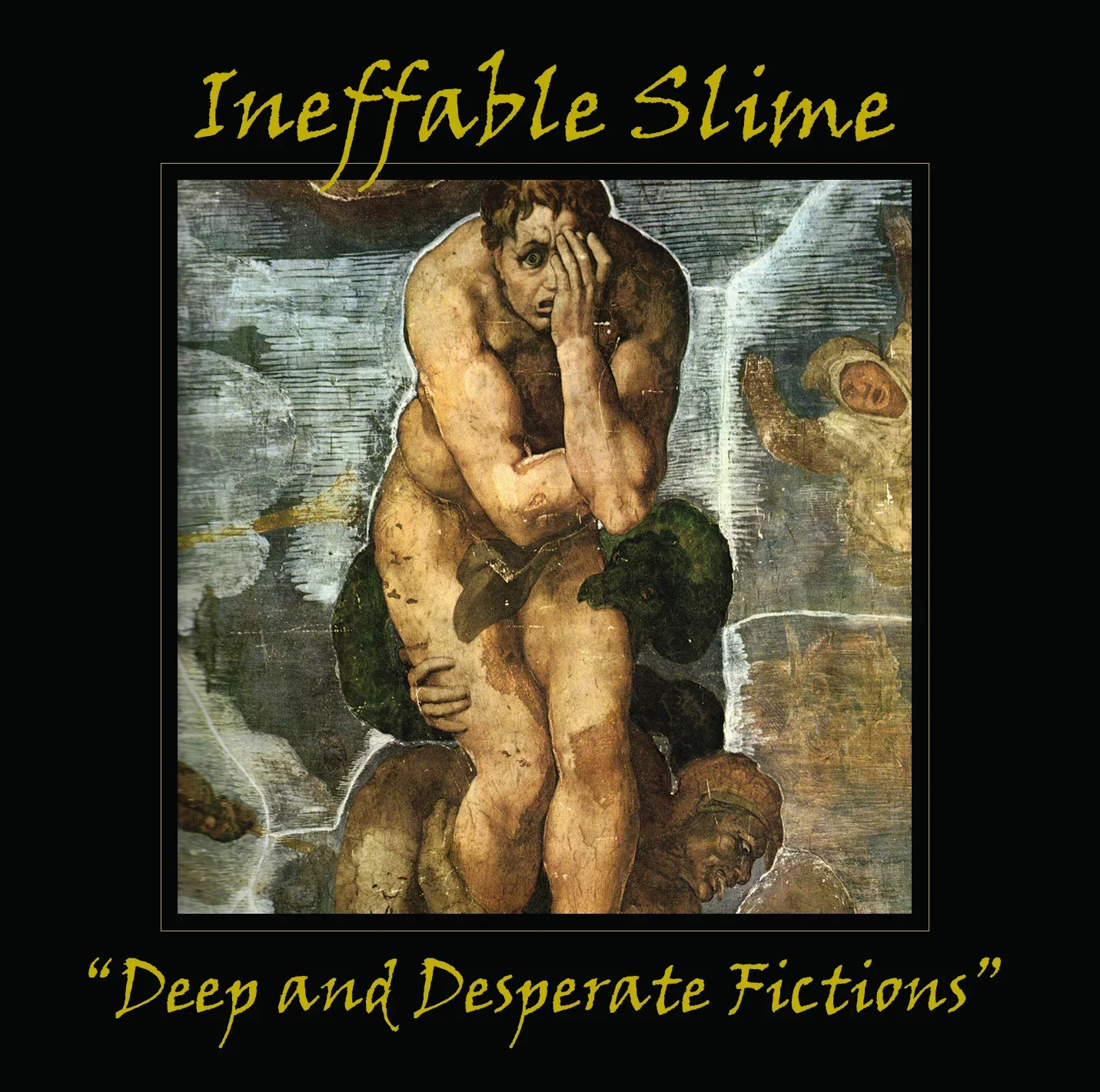
I first heard this afternoon during a bout of (somewhat frustrated) cleaning and organizing. My CD player has a particularly annoying quirk whereby I am forced to close the disc tray five or six times before it actually recognizes the disc. “Read the fucking thing!” I yell as I try to blow away the dust I imagine is coating the laser.
This does not always leave me in the best mood by the time the disc actually starts, so it took a bit of coaxing to get zoned in on today’s selection by Ineffable Slime, Deep and Desperate Fictions. Released late 2025 by Virtues, (the label of Alex Kmet/Climax Denial), I only recently got my hands on it via an as-yet-unfulfilled (on my end) trade with the artist.
Ineffable Slime has been operating since at least 2019, and the project’s aesthetic identity has been strong since its outset; a collision of disparate folkloric and pre-modern themes, with a healthy dose of old-school conspiracy-mongering. It all tracks given that slimist Ryan O’Connor also runs Alarum Books, a curated secondhand book and ephemera outlet that specializes in the aforementioned and adjacent.
The five tracks on Deep and Desperate Fictions flow together as one and all share a thoroughly blown-out atmosphere, but the sonics are crystal clear. There’s less of the typical Americanoise saturated crunch and more of a miasma that swallows the entire mid-range of frequencies. It’s the stuff on the outer extremes that I often find to be most engaging; “Feast of the Epiphany” is punctuated by frequent intrusions from a high-pitched beeping sound and bassy pulses that give the piece a lot of movement. Elsewhere, we’re treated to plenty of sputtering voltages and well-manipulated feedback. Whatever the gear configuration here, it’s clear that its operator has deft control of it.
The samples offer some additional context that I still can’t quite make heads or tails of; blown out orchestral easy listening on “Spinal Vertigo,” snatches of dialogue on opener “Cartesian Errata,” and occultist doomsaying on closer “Stupor Mundi.” It all adds up to a rather apocalyptic picture, though I can’t help but feel there’s something intentionally cyclical about the construction of this particular record. Death and rebirth; you know the vibes.
There’s a lot here I could point out that might have some kind of deeper meaning, like the AABCC structure of alliteration on the track titles, or the opener and closer both featuring repeating spoken word elements. That may just be conspiratorial pattern recognition on my part. It also might not. That’s where a lot of the enjoyment of this project comes from — following the clues and ending up with more questions.
