
8 classic analog synths for a range of budgets
Just getting into the world of synthesis? Our condolences to your wallet in advance; nothing exacerbates “gear acquisition syndrome” quite like synthesizers, particularly the analog variety. But don’t fret! While this list of 8 classic analog synths contains a few eyebrow-scorching price tags, our aim is to provide you with a range of options for getting your desired sound. These days, it’s easier than ever to get a close approximation of some of the most sought-after models. And if you want the real thing, then we have updated market values for winter ‘25/’26 — you just have to bring whatever you buy to the studio so we can play with it.
Moog Minimoog Model D (1970-1981)
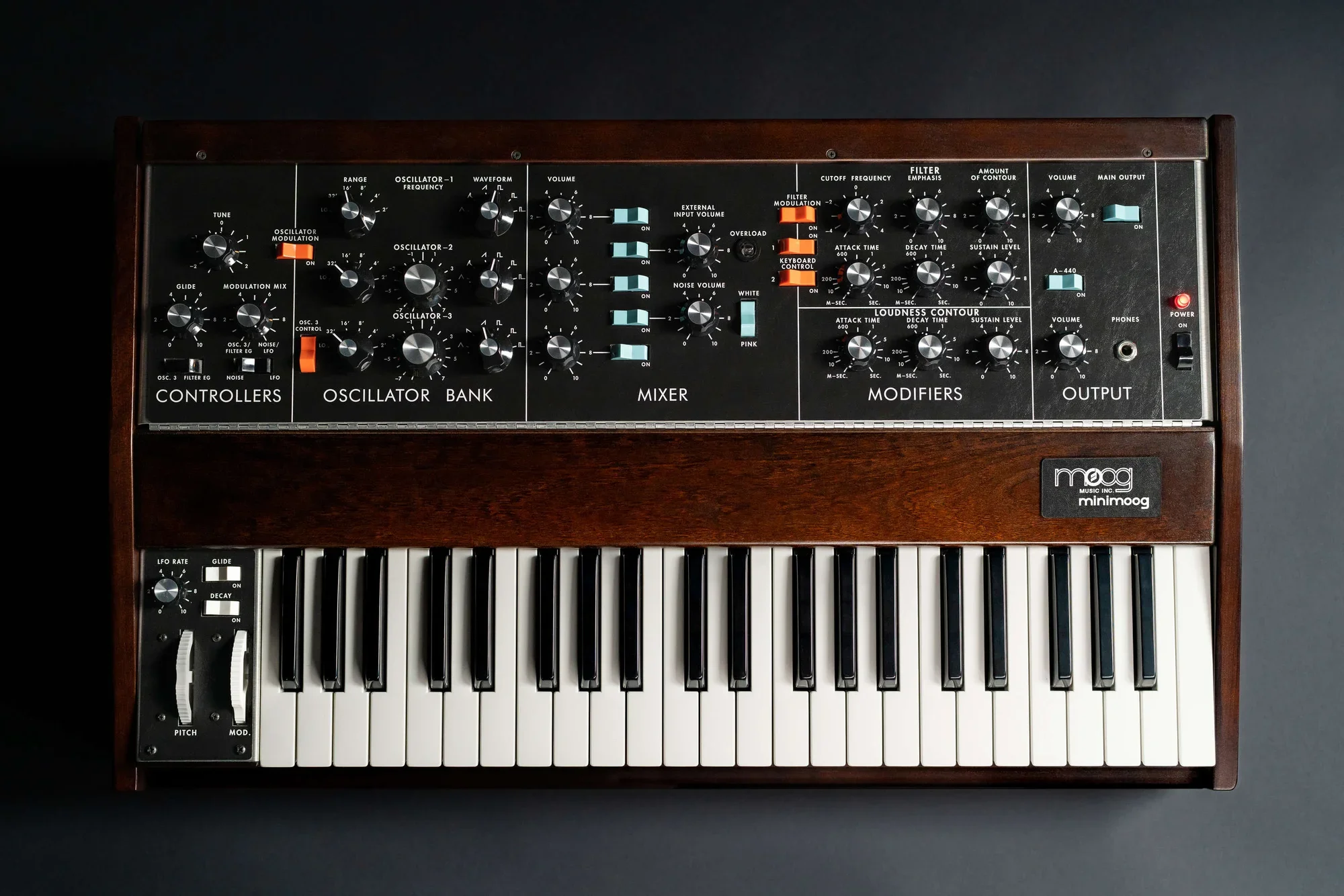
What it's known for: The definitive synthesizer bass sound
Filter: 24dB/octave transistor ladder filter. Loses low end at high resonance, (gets thinner, not more shrill)
Oscillators: 3 free-running VCOs that create natural beating when detuned
Famous for: Bass and leads — fat, warm, punchy low end
Artists who used it: Keith Emerson, Stevie Wonder, Dr. Dre, Parliament-Funkadelic
Current price: $3,200-$5,000+. Behringer makes a clone that runs approximately $249 and gets quite close. It’s generally regarded as one of Behringer’s finest hours.
Roland Juno-60/106 (1982-1986)
.jpg)
What it's known for: Lush pads, house stabs and the quintessential synthwave sound
Secret sauce: Built-in chorus circuit running at 0.4Hz and 0.6Hz — this IS the Juno sound
Oscillators: DCOs (digitally controlled, but analog) for tuning stability — less "alive" than VCOs, but more reliable
Filter: Smooth, non-aggressive — sits beautifully in mixes without harsh edges. (The Eurorack market, to be dissected in a future post, loves modules that are clones of this filter.)
Famous for: Pads, strings, warm beds that fill space
Artists: Depeche Mode, Tangerine Dream, most synthwave producers
Current price: Juno-60 at $2,500+, Juno-106 at $1,200-$1,500. Roland JU-06A is a respectable modern reproduction sans keyboard, and will run you a more reasonable $350-500.
Sequential Prophet-5 (1978-1984)
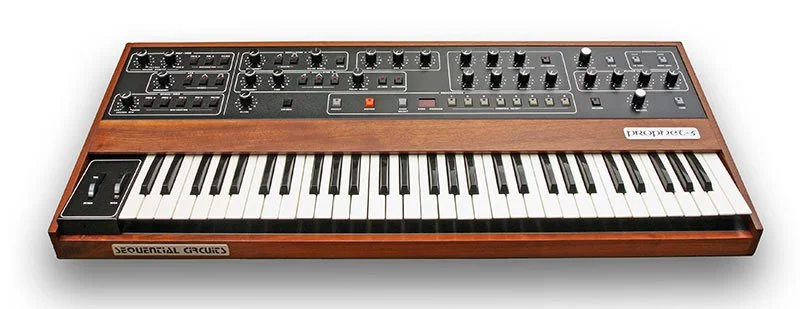
What it's known for: The 80s brass sound, polyphonic leads and cinematic textures
Key feature: First programmable polyphonic synth, allowing for saving and recalling patches
Filter: Curtis CEM3320 chips (Rev 3). These are sometimes described as "thinner" than earlier SSM chips.
Poly-Mod section: One oscillator can modulate another's pitch or pulse width.
Artists: Phil Collins ("In The Air Tonight"), Talking Heads, Vangelis (Blade Runner OST)
Current price: $6,000-$8,000. The new iteration of Sequential also has the Take 5, a more compact clone of the P5 that sacrifices a few features (and that sexy wood paneling) at a $1400 price tag.
Oberheim OB-X / OB-Xa (1979-1985)

What it's known for: Massive, wall-of-sound textures for arena rock
Filter: 12dB/octave state-variable (SEM) — unique resonant sweep character
Unison mode: Stacks all voices on one note for enormous lead sounds
Character: Often described as "aggressive" or "pissed-off" compared to Prophet's smoothness
Artists: Van Halen ("Jump"), Rush ("Tom Sawyer"), Prince
Current price: $8,000-$12,000. Oberheim’s own TEO-5 is around $1100 with some more modern bells and whistles. And of course, the Behringer UB-XA can be found for anywhere between $850 and $1300, making it one of the more expensive (though, some say, of higher build quality) Behringer reproductions.
ARP 2600 (1971-1981)

What it's known for: Semi-modular flexibility, sound effects, expressive leads
Design: Works without patch cables but allows extensive re-routing
Filter: Pre-1976 units have Moog ladder clone — post-1976 use ARP's own design
Famous sounds: R2-D2's voice, Ark of the Covenant, Madonna's "Borderline" bassline, Michael Jackson’s “Thriller” bassline
Current price: $10,000-$15,000 (only ~3,000 ever made). Korg’s similarly limited reproduction fetches anywhere from $1200 on the used market to $1800 new, but Behringer have made a relatively faithful reproduction for just under $500 in all the color schemes (including the sought-after Blue Marvin.)
Roland SH-101 (1982-1986)

What it's known for: Squelchy acid bass, punchy monophonic leads
Character: Close cousin to TB-303 — the filter is the star, and the resonance absolutely screams.
Sequencer: Built-in 100-step sequencer that became an industry template
Artists: Orbital, The Prodigy, Aphex Twin, early house producers
Current price: The original runs $1,000-$1,500; Behringer’s MS-101 clone is around $350. Donner, known as a competitor in the $30 guitar pedal market, also makes the Essential L1 for about $220.
Korg MS-20 (1978-1983)

What it's known for: Aggressive, nasty, distorted tones
Dual filter: 12dB high-pass into 12dB low-pass — unique bass boost capability
Character: Harsh and unruly sometimes, but more than capable of creamier tones.
Special feature: The extensive patch bay allows for complex re-routing options. But the real star is the external signal processor, which lets you run just about anything through the filters and envelopes. You can even use it to control pitch; we like using it with guitars.
Artists: Aphex Twin, Daft Punk ("Da Funk"), 1980 Doctor Who theme, Liaisons Dangereuses, The Fall
Current price: Vintage $1,000-$1,500; Korg’s MS-20 Mini ~$500; Behringer K2, ~$250.
Yamaha CS-80 (1976-1980)
_8-voices_dual-layered_analog_polyphonic_synthesizer,_with_22_preset_sounds_&_6_user_patches_-_VINTAGE_SYNTH_@_YAMAHA_BOOTH_-_2015_NAMM_Show.jpg)
What it's known for: Among the most expressive analog synths ever made. Highly cinematic and proficient at orchestral tones.
Key features: Polyphonic aftertouch per note, velocity sensitivity, two complete synthesis layers
Why it matters: Responds like an acoustic instrument. Vangelis called it "the only real instrument".
Famous for: Blade Runner soundtrack, evolving cinematic textures
Current price: $25,000-$50,000 (over 200 lbs and a total maintenance nightmare). The Black Corporation Deckard’s Dream is a nice recreation that will still run you $4200; nothing to sneeze at, but much less than a down payment on a house.
