
In defense of the digital multitracker
The music world is, understandably, still obsessed with multitrack tape recorders. 1979 saw the introduction of the very first Portastudio, allowing musicians to finally do what they’d always wanted: make decent-sounding recordings at home. Of course, the idea was more that it would simplify the creation of demo recordings. But ingenuity quickly took hold, and the sudden democratization of recording one’s own music created an explosion of incredible lower-fidelity music that continues to this day.
Nowadays, nostalgia is a powerful factor driving the use of these machines. Guitarists love to repurpose old Portastudios for their particularly gritty preamp sound; adding tape saturation and dirt to drums is as simple as recording to a blank tape; and experimental musicians are still finding interesting ways of innovating on 4-track tape loops. Unfortunately, that means prices have also skyrocketed. Where you used to be able to find these at Goodwill with some regularity, you’re lucky if you can pay less than $400 for a mostly functioning unit these days.
Enter the digital multitracker. It was the obvious next step in the development of home recording. Digital technology had been used on tape machines for about as long as they’ve existed, and the ADAT utilized a VHS-style format to allow for the storage of up to 8 tracks. But purely digital multitrackers began to utilize formats like compact flash cards and, later, SD cards for increasingly quick recall and more complex functions.
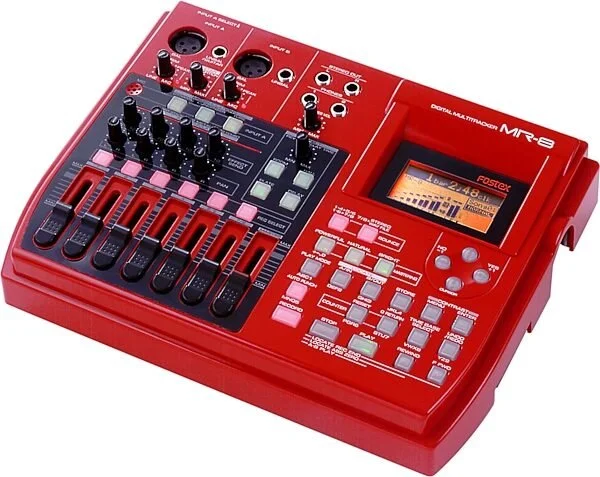
Perhaps predictably, they haven’t really taken hold of the nostalgic mind quite the same way that tape has. I would argue, however, that they have just as much utility as a portastudio. I have used a Fostex MR-8 for both traditional recording and experimental purposes for about two years now, and continue to find new applications for it. These offer eight tracks of recording, effect sends on the first four channels, compression, looping, and, best of all, almost never exceed $100 on the used marketplace.
You can drive the hell out of your line inputs with the built-in amp sims which, while certainly digital, have a distinct character all their own. And, should you ever feel like getting a little strange, all these digital effects are a fountain of possibilities for drones and soundscapes. I personally love to add a different loop on each channel, dial in the effects, and bring them in and out at different levels to create an evolving wall of noise. You could have just as much fun using the same loop knocked slightly out of phase for some Terry Riley-style strangeness.
This is not to say that you need to go get yourself an MR-8 specifically. There are plenty of manufacturers making cheap digital multitrackers to this day that can accomplish the same and greater functions. But the message here is more that you don’t need to shell out a ton of money to create singular sounds. The best music is often made from limitations, and the urgency with which it’s made using whatever tools are available.
So, the next time you find yourself perusing Facebook Marketplace hoping a Portastudio shows up for $200, consider buying that $60 digital recorder from someone’s uncle instead. See what you can come up with — that’s the fun of it, after all.
